
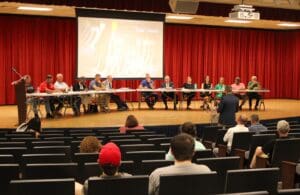
As the use of artificial intelligence rises, more and more data processing centers are sprouting up across the country. Citizens and local utility leaders shared their thoughts concerning zoning requirements for data centers at a public hearing hosted by Community and Development Services (CDS) on Monday.
At the forum, CDS shared zoning draft documents for data centers. According to the draft, a small-scale data center has foot print of less than 10,000 square feet and has an electrical load less than five megawatts; a medium-scale data center has a footprint of less than 20,000 square feet and has an electrical load less than 20 megawatts and a large-scale data center has a footprint of less than 50,000 square feet and an electrical load less than 75 megawatts.
Hyper-scale data centers surpass large-scale data centers, and the zoning draft prohibits them from being built in Hopkinsville.
In the draft, small-scale data centers have a minimum setback of 100 feet, medium-scale data centers have a minimum setback of 200 feet and large-scale data centers have a minimum setback of 500 feet. The set back distances increase if the surrounding property is under residential, public or quasi-public use.
Data centers will also be required to use a closed-loop cooling system, which recycles cooling liquids that contain water.
Hopkinsville Electric System Board Attorney Jack Lackey Jr. spotlighted some zoning amendments proposed by the electric utility company. Some of the zoning recommendations such as the setback distances, megawatt caps and the implementation of closed-loop cooling systems were included in the CDS zoning draft.
However, Lackey says some of the zoning regulations could lead to data centers impacting farm land in Christian County.
Hopkinsville Water Environment Authority General Manager Melissa Spurr says water use for data center cooling can greatly vary. Spurr says some data centers consume extremely high quantities of water, while others consume around six residences worth of water. If a data center is set to come to town, Spurr says HWEA will review its water needs first.
Many citizens shared their concerns surround data centers, Steven Brooks of Christian County thought that the zoning guidelines needed to include more environmental protections. He says data center cooling systems have had leaks, and if that were to happen in the county it could impact local wildlife.
Christian County is known for agriculture, and Sherry Byerline of Pembroke says if data companies start buying up land impacting farmers. In Texas, Byerline says farmers are struggling, because land that has been bought by data companies has been repriced at a higher cost.
On the flipside, Robert Ison, a Hopkinsville attorney, shared that the city can welcome a data center while also working to ensure it does not negatively impact citizens or the environment. He says if CDS and the Hopkinsville City Council approve the stricter zoning regulations; data centers would basically be banned in Hopkinsville.
Current data center zoning documents drafted by CDS are available at comedev-services.com.